
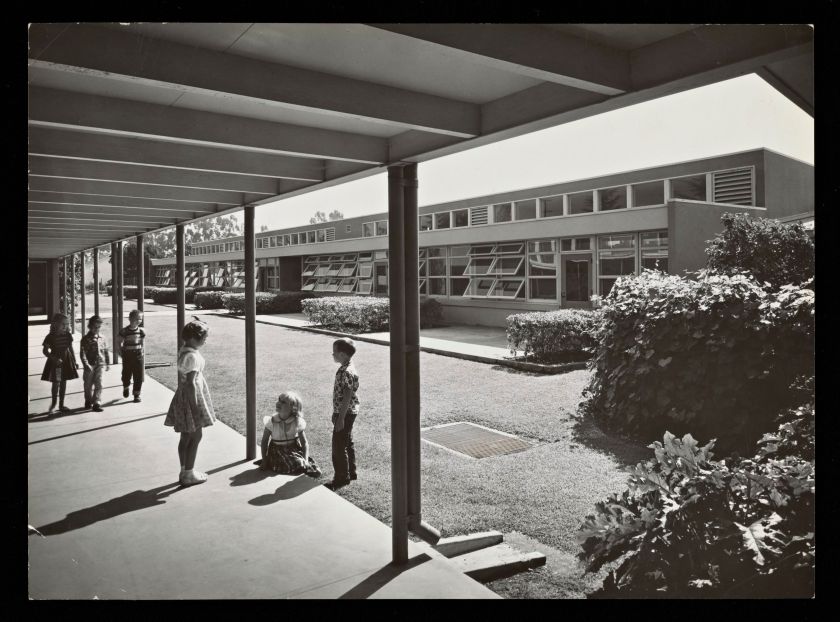
Significant changes in school architecture occurred after World War II in the United States. The postwar baby boom generated a need for the rapid construction of new school sites and sites that could be more easily expanded. Demographics plus a shift in educational pedagogy and technology emphasized the need for buildings beyond classical and historical styles. One-story, flat-roofed buildings accommodated that need. Features of these mid-century modern learning environments included more emphasis on:
- Natural light
- Ventilation
- Large windows
- Open corridors
- More specialized spaces such as gyms and shops
The principles of modernism in school design became linked to the progressive pedagogies of flexibility, adaptability, and connectivity to the natural environment and school architects embraced many of the same principles of design and materials as their civic and residential colleagues with clean lines and minimal ornamentation.
Firms such as Smith, Powell & Morgridge played a large role in shaping educational architecture in California during the postwar era from elementary schools to higher education campuses.
Photo: Thomas Jefferson Elementary School, 1954. Smith, Powell & Morgridge. Photographer, Julius Shulman. Getty Research Institute.
 Wayfind Education